SeqBench
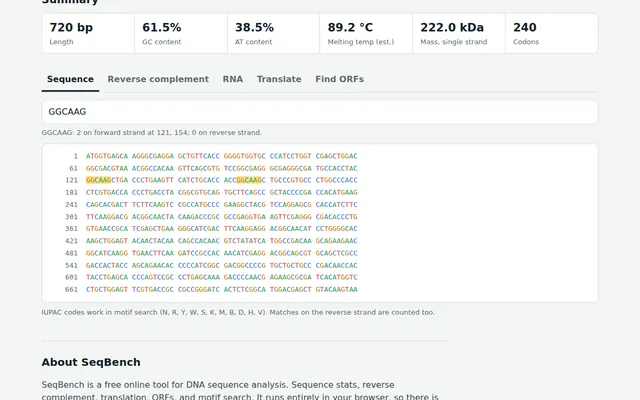
Sequence stats, reverse complement, six-frame translation, ORFs, and motif search.
Gataca Corporation builds bioinformatics tools that expedite genomics research. We apply cutting-edge technology, including artificial intelligence, so your team gets from raw sequencing data to reliable results faster.
That's us, somewhere in every read.
Tools, models, and pipelines that take the computational bottleneck out of genomics research.
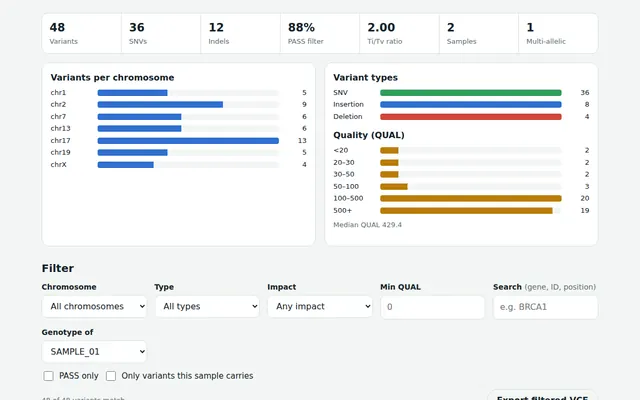
Six free, browser-based tools that speed up routine work, from primer design to variant review.
Machine learning models that speed up interpretation and help surface patterns in large, complex datasets.
Alignment, variant calling, annotation, and interpretation-ready reports for whole-genome, exome, and targeted panels.
Bulk and single-cell RNA-seq: quantification, differential expression, clustering, and pathway analysis.
Reproducible, containerized workflows that run the same way on a laptop, a cluster, or the cloud.
Tools, dashboards, and integrations built around your lab's data and the way your team works.
We learn your biological question, data types, and constraints, then agree on deliverables and timeline.
We design the analysis or pipeline, validate it against known data, and share progress as we go.
You get results, documented code, and a clear write-up of methods you can cite or hand to reviewers.
We stay available for reruns, new samples, and questions once the work is in your hands.
Biology can now write DNA, not only read it — and AI has started to help design what gets written. We keep a plain-English guide to what that really means, with established results separated clearly from what has not happened yet.
Genomes assembled from manufactured DNA have been running cells since 2010, and a bacterium cut down to fewer than 500 genes has been studied since 2016 — with about a third of those genes still unexplained.
Designed proteins work and won a Nobel Prize in 2024. Genome-scale sequence models are newer and useful for ranking candidates. No AI has designed a free-living organism, and none is close.
Xenobots and anthrobots are clusters of living cells, not machines. DNA origami and biohybrid microrobots are real laboratory work. None of it is in routine clinical use.
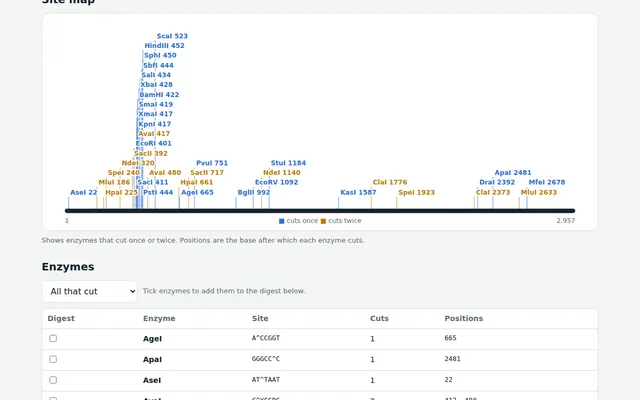
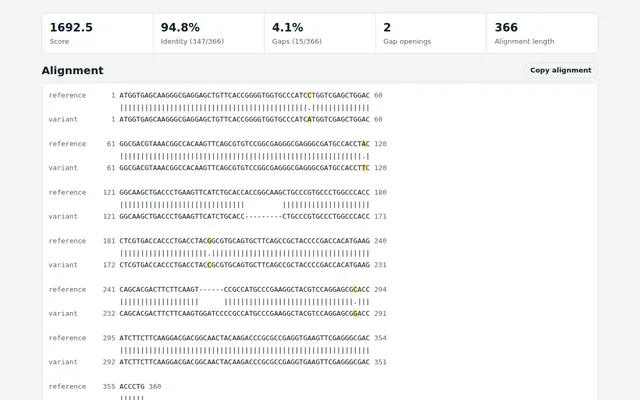
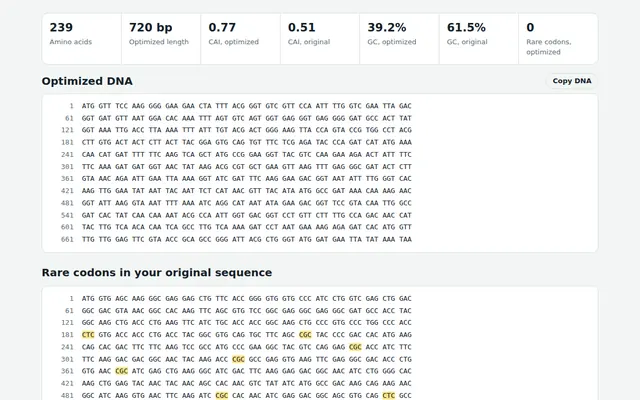
Six tools for everyday genomics work: sequence analysis, primer design, restriction mapping, alignment, codon optimization, and VCF review. Each runs in your browser, so your data never leaves your device.
Sequence stats, reverse complement, six-frame translation, ORFs, and motif search.
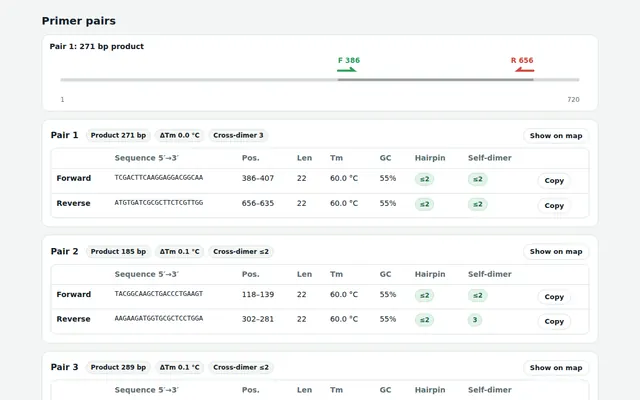
PCR primer pairs ranked by nearest-neighbor Tm, with hairpin and dimer checks.
Tell us about your project and we'll get back to you within two business days.